Louisiana v. Callais No. 24-109 Decided April 29, 2026 ← Back to extras
VOID RACIAL GERRYMANDER
Supreme Court of the United States — April Term 2026
Louisianav.Callais

Race Out.

Vote
6 — 3
Ideological split
Majority
Alito, J.
Roberts · Thomas · Gorsuch · Kavanaugh · Barrett
Dissent
Kagan, J.
Sotomayor · Jackson
Holding
Map struck.
14th Amendment violation
Allowing race to play any part in government decision-making represents a departure from the constitutional rule that applies in almost every other context.
I · The exhibits

One state. Three maps.

Louisiana redrew its congressional districts twice between 2022 and 2024. The Court took one of those maps off the wall and pinned it to the bench as exhibit A in a racial-gerrymander case.

Predecessor
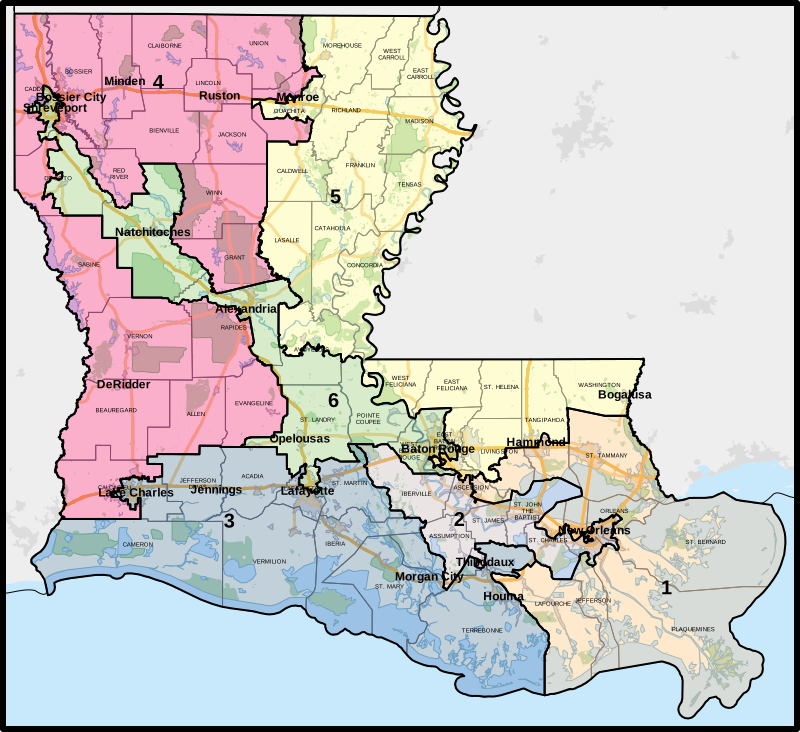
Map I · 2022 baseline
The first map
One Black-majority district. Federal court found this violated Section 2 of the Voting Rights Act in Robinson v. Ardoin.
Louisiana congressional districts under the 2022 Robinson-era map (118th Congress). One majority-Black district: CD-2, the urban New Orleans corridor.
Map: Wikimedia / Twotwofourtysix · CC BY-SA 4.0
Maj-Black
1 / 6
Drawn
2022
Status
Replaced
Federal Judge Shelly Dick ordered Louisiana to add a second Black-majority district in June 2022. The legislature's first map didn't comply.
Struck down
Map II · SB8 (Act 2)
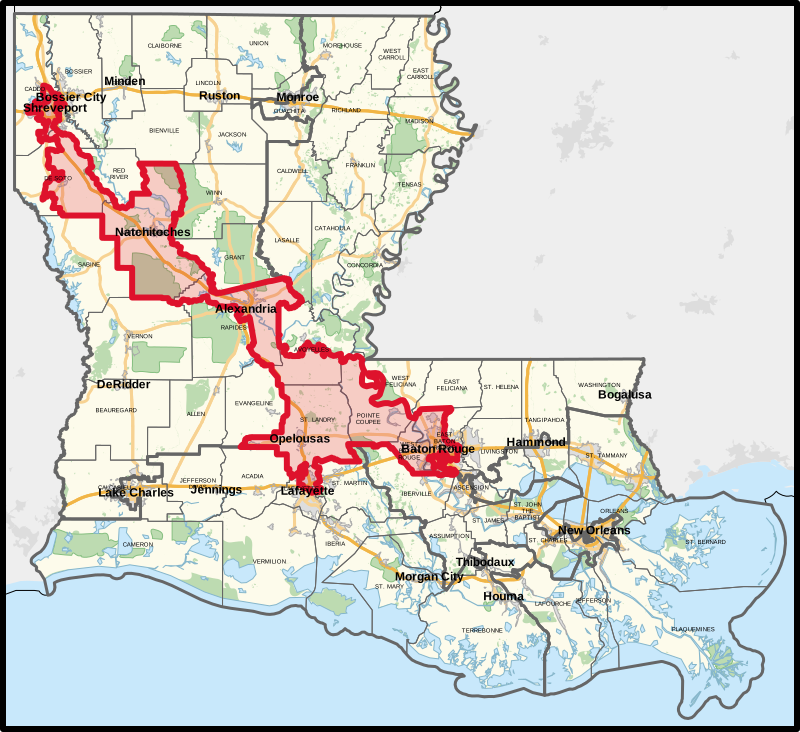
The 250-mile backslash
CD-6 redrawn from Shreveport diagonally through Alexandria and Lafayette to Baton Rouge. The Court called it a racial gerrymander.
Louisiana congressional districts under the SB8 map (119th Congress) — struck down April 29, 2026. Two majority-Black districts: CD-2 (urban) and CD-6, the diagonal Shreveport-to-Baton Rouge district.
Map: Wikimedia / Twotwofourtysix · CC BY-SA 4.0
Maj-Black
2 / 6
CD-6 Black VAP
54%
Status
Voided
The legislature lifted CD-6 from 23% Black VAP to 54% in a single session. Cleo Fields (D) won the seat in November 2024. The Court ruled today that the line-drawers leaned too hard on race.
Pending
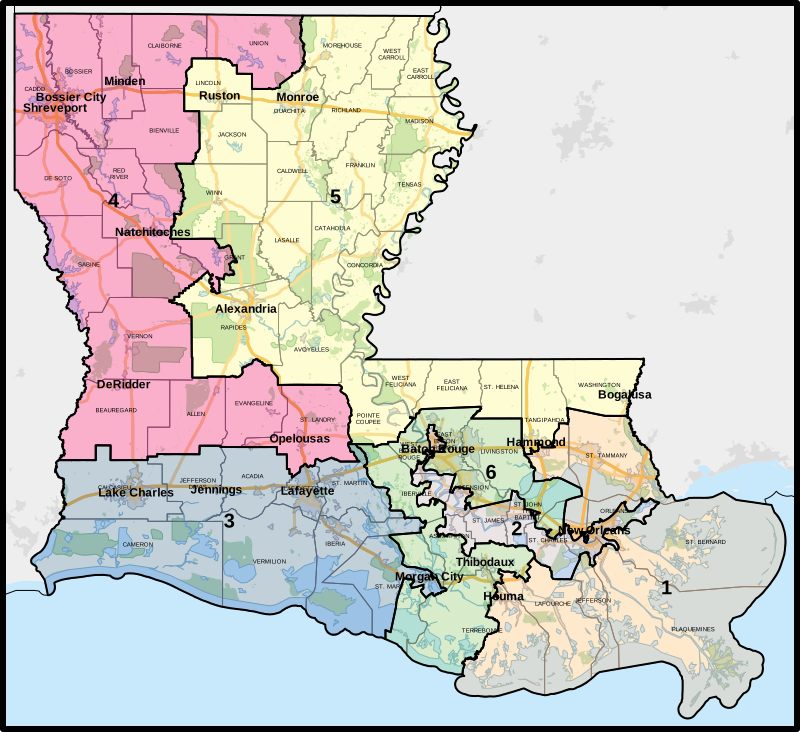
Map III · Remand
The replacement
Back to Louisiana to redraw — or to a federal court if the legislature stalls. Same problem, narrower path through the new Section 2 tests.
? AWAITING LEGISLATIVE ACTION
Maj-Black
TBD
Deadline
2026 cycle
Status
Remand
The legislature gets first crack. If they punt, the Western District of Louisiana draws the next one. Either way: the Section 2 path just got four locks added to it.
Louisiana's 6th Congressional District as drawn under SB8 — outlined in red running diagonally from Caddo Parish (Shreveport) southeast through Natchitoches, Alexandria, Opelousas, to East Baton Rouge Parish.
Map: Wikimedia / Twotwofourtysix · CC BY-SA 4.0
II · Anatomy of a snake

The line that broke the rule.

CD-6 used to be a Baton Rouge anchor. SB8 stretched it across two-thirds of the state on a single mission: hit 50 percent Black VAP. The path was the giveaway.

You can't draw a 250-mile diagonal through three regions and tell a federal court the route was about anything other than the racial composition of the neighborhoods you grabbed on the way.

  • Length ~250 miles of contiguous district running northwest to southeast.
  • Black VAP Lifted from 23% to 54% in one redraw.
  • Trace Hugs the Red and Mississippi rivers, threading majority-Black neighborhoods through Caddo, Rapides, East Baton Rouge.
  • Holding The Court found the route was "explicable only by reference to race."
III · The new locks

Four reasons the old Gingles test no longer fits.

The Court didn't kill Section 2. It said the 1986 Gingles framework was built for a country that doesn't exist anymore, and added four new considerations every plaintiff has to clear. Kagan calls this killing the statute slowly. Either way, the door is much smaller than it was yesterday.

01
Consideration I

No more entrenched Jim Crow.

The Southern political machinery that Section 2 was written to break is gone. The majority says courts can no longer presume the same baseline of state hostility that justified race-conscious remedies in 1965 or 1986.

02
Consideration II

Race tracks party.

In a polarized two-party system, race and partisan affiliation correlate sharply. A "racially polarized vote" under Gingles is now functionally indistinguishable from a partisan vote — which the Court has already pulled out of federal jurisdiction.

03
Consideration III

Rucho closed the partisan door.

Rucho v. Common Cause (2019) made partisan gerrymandering nonjusticiable in federal court. Using race as a proxy for party to get the same remedy through the side door of Section 2 is, the majority holds, an end-run around Rucho.

04
Consideration IV

The computers can do it now.

Plaintiffs can run millions of race-neutral simulated maps and show the state's plan is an outlier. That tool didn't exist in 1986. Courts no longer need to take race-conscious redraws on faith — and the majority says they shouldn't.

IV · The dissent
The consequences are likely to be far-reaching and grave. Today's decision renders Section 2 all but a dead letter.
The 2A angle

A redistricting case is also a gun rights case.

The Fourteenth Amendment doesn't come in flavors. The same Equal Protection muscle the Court just flexed against race-based map drawing is the muscle that has to flex when state legislatures write gun laws that target some Americans and not others.

The colorblind Constitution isn't a slogan. It's a rule the government has to live by, and it's the rule the Bruen-era Second Amendment leans on every time a prohibited-person statute or a may-issue regime gets dragged into court.

The history is ugly. Slave codes, Black Codes, the Mulford Act — American gun control was built, more than once, as a tool of racial control. Courts have spent the last decade dragging that history into the light because Bruen made history dispositive.

What Callais reinforces: when the government makes a decision that turns on race — whether the decision is which neighborhoods share a congressman or which citizens get a permit — the Equal Protection Clause forces strict scrutiny and a colorblind alternative.

That principle cuts every direction. It strikes down a gerrymander that packed Black voters. It would strike down a gun-permitting scheme that disqualifies Black applicants by proxy. And it pulls a thread that runs straight back to Heller, Bruen, and the "text, history, and tradition" test that gun owners now rely on as our floor.

The same Fourteenth Amendment that protects a redistricting plaintiff protects a gun owner.

Read Callais as a doctrine memo, not a redistricting memo. The Court is reaffirming, in stark terms, that government acts based on race trigger the highest possible scrutiny — and that legislatures don't get to wave away that scrutiny by claiming a remedial purpose.
McDonald v. City of Chicago
2010
Incorporated the Second Amendment against the states through the Fourteenth. Same amendment Callais is fought over.
Students for Fair Admissions v. Harvard
2023
Killed race-conscious admissions. Same colorblind Constitution; same Equal Protection clause; same six justices.
N.Y. State Rifle & Pistol Ass'n v. Bruen
2022
Set the "text, history, and tradition" test for gun laws — the test that is now exposing the racial history of American firearm regulation.
Rucho v. Common Cause
2019
Held partisan gerrymandering claims aren't justiciable in federal court. Callais closes the racial end-run around Rucho.
District of Columbia v. Heller
2008
Recognized the individual right to keep and bear arms. Anchored in the same individual-rights framework that Callais reinforces.
V · What happens next

Three clocks start running.

Decided April 29. The remand starts immediately. The Louisiana legislature gets the next move — and so does every state carrying a similar map under fresh scrutiny.

Now — Apr 29
Remand to the Western District of Louisiana
The three-judge panel that originally found CD-6 unconstitutional gets the case back. They oversee the redraw and approve any replacement plan the legislature files.
Within weeks
Louisiana legislature drafts a remedial map
The state gets the first opportunity to draw a new plan that satisfies both the Voting Rights Act and the new four-factor constitutional ceiling. Cleo Fields' CD-6 seat is the variable.
Before 2026 elections
A working map by qualifying
Louisiana qualifying for federal office runs in July. Either the legislature delivers a court-approved map by then or the federal panel imposes one in time for ballots to print.
VI · The ripple

Four states with similar maps under fresh scrutiny.

The four-factor framework applies everywhere. These are the maps most likely to land back at SCOTUS or in a remand court before the 2026 cycle closes.

AL
CD-2 redrew under Allen v. Milligan
Same procedural posture as Louisiana — a court-ordered second Black-majority district. Now exposed to the new tests.
GA
CD-6 / Atlanta exurbs
Pending Section 2 challenges in the Northern District. The Callais framework changes how plaintiffs have to plead them.
SC
CD-1 / Lowcountry
Already up to SCOTUS once. Returns to lower courts under a tighter ceiling on race-conscious remedies.
NC
CD-6 / Triad
Long-running fight over Greensboro-area lines. The new framework gives the state stronger footing on remand.